
Are you an IT expert with a non-ICT degree or no university qualification at all? In the eyes of the Australian Computer Society (ACS), your years of “on-the-job” learning are just as valuable as a degree—if you can prove it.
The Recognition of Prior Learning (RPL) report is your opportunity to showcase that your real-world experience meets the Australian standards for ICT professionals. However, with ACS’s 2026 updates to AI detection and technical scrutiny, a “good” report isn’t enough; it must be flawless.
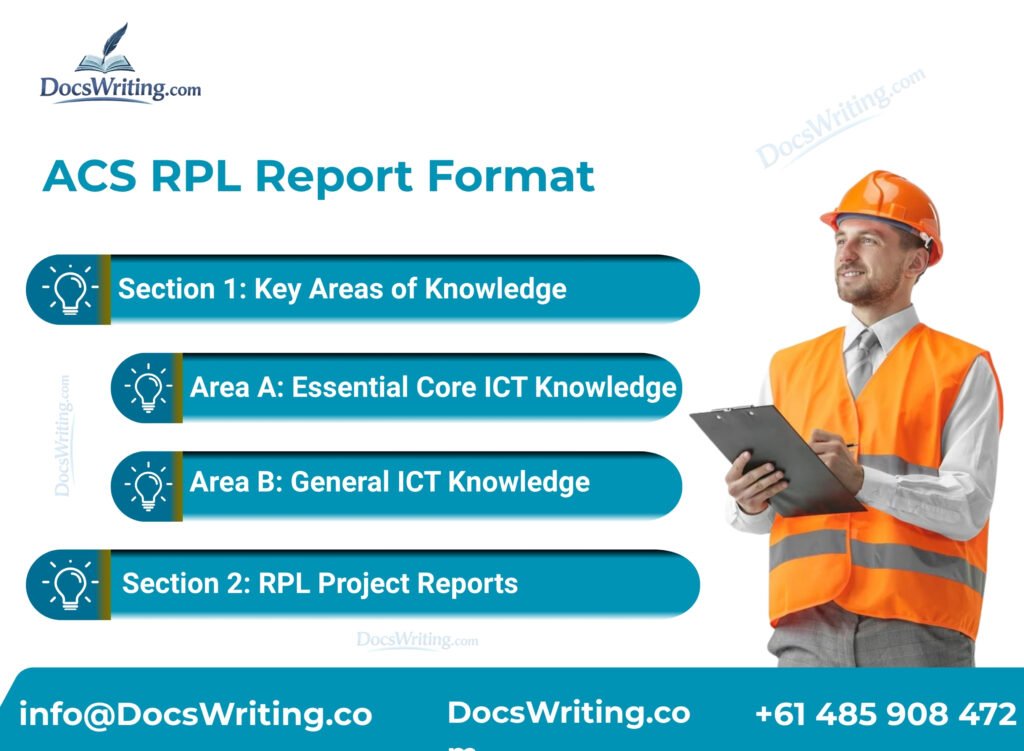
The Two Pillars of a Successful RPL Report
An ACS RPL application is divided into two distinct, high-stakes sections:
Section 1: The Key Areas of Knowledge (KAoK)
This is where you prove your theoretical understanding. You must explain how your career has taught you the “Core Body of Knowledge.“
-
The Goal: Link your practical work to ICT fundamentals like Data Structures, Networking, and Software Engineering design.
-
The Requirement: Provide short, technical “essays” (approx. 750 words each) for at least two sub-topics per area.
Section 2: The Two Project Reports
You must submit two detailed project reports that act as the evidence of your seniority.
-
Project 1: Must be from the last three years.
-
Project 2: Must be from the last five years.
-
The “I” Narrative: Like a Career Episode, these must be written in the first person (e.g., “I implemented the SQL database architecture”), focusing on your individual technical decisions.
2026 Critical Success Factors
| Feature | Requirement for Success |
| ANZSCO Alignment | Your duties must match 65%–70% of the nominated occupation’s tasks. |
| Experience Threshold | 6 years for non-ICT degree holders; 8 years for those with no degree. |
| Evidence Quality | Must include system topology diagrams, ERDs, or snippets of design logic. |
| Originality | ACS uses Turnitin and advanced AI-Detection software to flag non-original content. |
Why Most RPL Applications Fail
-
Vague Descriptions: Saying “I was involved in the migration” is a red flag. ACS wants to know the tools (e.g., Azure, Jenkins), the methodology (e.g., Agile/Scrum), and the result.
-
Plagiarism from Samples: Thousands of engineers download “Sample RPLs” and tweak them. ACS has a database of every report ever submitted. Even minor similarities can lead to a 3-year ban.
-
Mismatch with References: If your RPL claims you are a “Cyber Security Specialist” but your employer’s reference letter says “IT Support,” your application will be rejected immediately.
How Our RPL Writing Services Secure Your Future
Writing an RPL while working a full-time IT job is exhausting. Our professional writers—who are ICT experts themselves—help you by:
-
Identifying the Best Projects: We scan your career history to find the two projects that most easily prove your competency.
-
Technical Diagramming: We help create the architectural diagrams and flowcharts that ACS assessors love to see.
-
Plagiarism & AI Cleaning: Every report we write is scanned with premium tools to ensure it is 100% human-written and unique.
-
ANZSCO Mapping: We ensure your technical language aligns perfectly with your chosen code (e.g., 261313 Software Engineer or 261111 Business Analyst).
SEO Details for Your Website
-
Slug:
acs-rpl-report-writing-service-ict-australia -
SEO Title: ACS RPL Report Writing Service | ICT Skills Assessment 2026
-
Meta Description: No IT degree? No problem. Our expert ACS RPL report writing services help ICT professionals secure a positive skills assessment for Australian migration. 100% original & EA-compliant.
